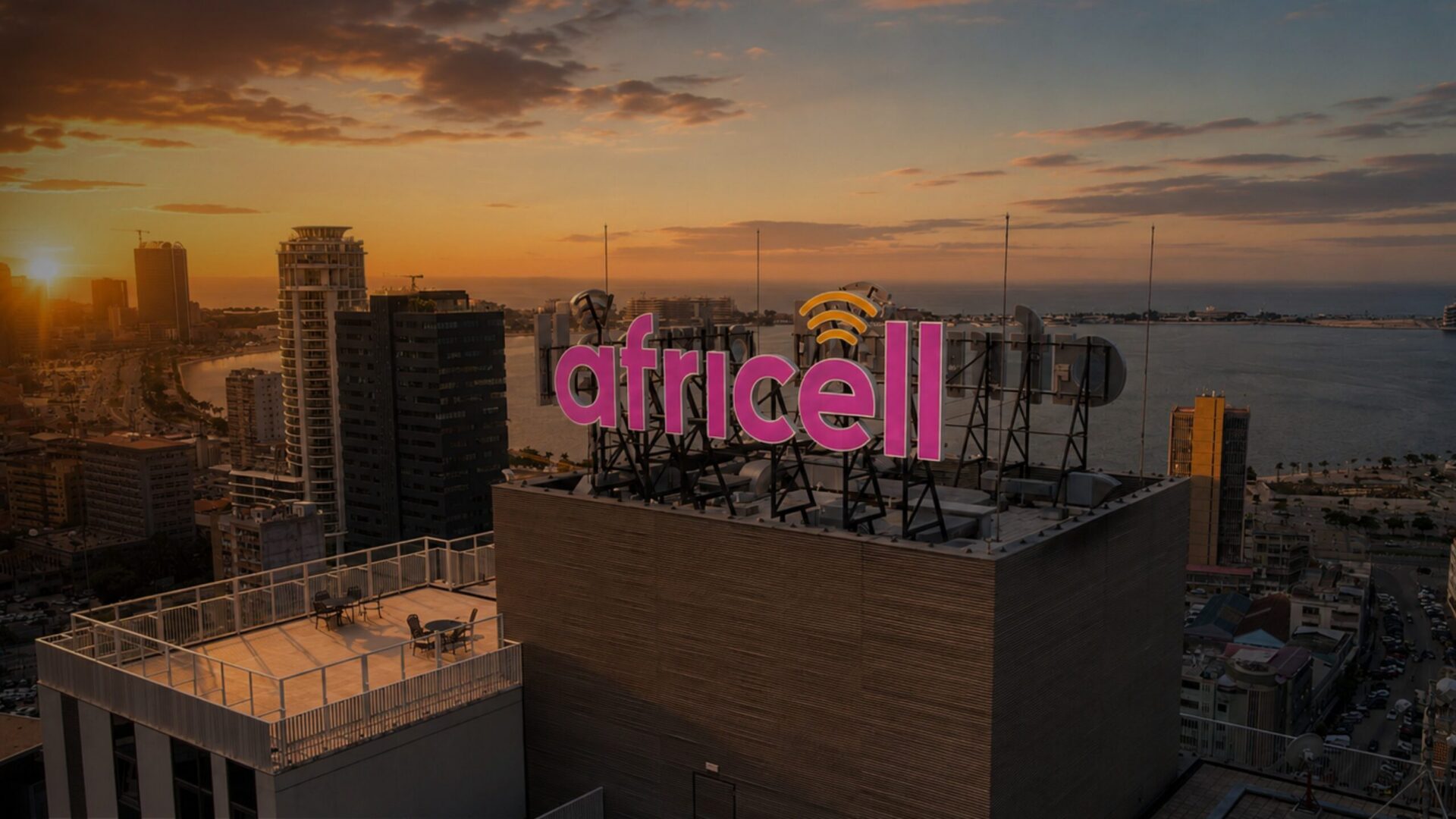
On 11 September 2026, the Export-Import Bank of the United States announced a $99.6 million direct loan to Africell. According to the operator, the funds will support American and European mobile network technology for its operations in Angola.
The announcement is significant, but it does not yet prove that digital payments will improve. The financing primarily targets telecommunications infrastructure. To affect Afrimoney, the investment must improve several links in a broader operational chain.
What has been established
Africell has operated in Angola since 2022. The group says it passed eight million customers in the country in August 2026. This is a company-reported figure and does not, by itself, measure active use of financial services.
On 16 September, Africell also announced the launch of its services in Soyo, Zaire Province. Residents and businesses in the port city can now access voice, data and Afrimoney services. Africell says the municipality is home to more than 200,000 people.
Across the group, Africell describes Afrimoney as a mobile money platform used by more than 1.5 million customers in four countries. Registered customers must still be distinguished from active users, transaction frequency and the value actually transferred. Detailed public data on these measures was not available in the sources reviewed.
A telecom investment is not yet a payment investment
A mobile payment depends on several layers.
The first is network access. It includes radio coverage, capacity, signal availability, the reliability of USSD or data sessions and latency. The announced loan can directly affect this layer if the equipment is deployed and maintained as planned.
The second is the transaction platform. It includes customer identification, authentication, the electronic ledger, fraud controls, limits, notifications, reversals and refunds. Better coverage does not automatically correct a weakness in this platform.
The third is the agent network. A customer may have a strong signal and still be unable to cash in or cash out if the nearest agent lacks cash or electronic value.
The fourth covers settlement, compliance and interoperability. It determines how funds move between Afrimoney, banks, merchants and other networks. The financing announcement does not yet document changes to these functions.
This distinction matters because network expansion, wallet registration and effective payment use are different outcomes.
How the loan’s real effect should be measured
A rigorous evaluation should compare performance before and after the new investment while separating established coverage areas from newly opened locations. Soyo could provide a useful case if Africell, the regulator or researchers publish sufficiently detailed data.
Priority indicators would include:
- network availability and outage duration;
- success rates for USSD sessions and app connections;
- Afrimoney transaction success rates;
- average response time and the share of timed-out transactions;
- frequency of duplicate transactions, reversals and adjustments;
- 30-day and 90-day active users;
- density of active agents and their liquidity availability;
- total transaction cost for customers and merchants;
- complaint volumes and resolution times;
- reported fraud incidents relative to transaction volume.
These measures would test a clear hypothesis: network investment improves payments only when better coverage and availability translate into completed transactions.
A practical approach would compare changes in Soyo with a similar city where the service was not introduced at the same time. This would reduce the risk of attributing to Africell changes that were instead caused by economic growth, new regulation or a broader shift in digital behaviour.
The technology dependency question
The loan also has a geopolitical dimension. Reuters and the Associated Press place it within a US strategy to promote non-Chinese equipment in Africa. Africell says American and European technology will strengthen security, resilience and national control of infrastructure.
That claim also needs to be tested. Supplier diversification can reduce excessive concentration, but replacing one dominant supplier with another does not guarantee autonomy. Resilience also depends on spare parts, local technical skills, maintenance terms, total lifecycle cost, data portability and the ability to change suppliers.
This is especially relevant to payments. A network outage can prevent authentication, interrupt a transaction or delay confirmation. A resilient architecture therefore requires redundancy, disaster recovery, real-time monitoring and clear adjustment procedures.
What Soyo may reveal
Soyo is an industrial port city connected to the oil sector. The simultaneous arrival of telecom and Afrimoney services may reveal demand for person-to-person transfers, bill payments, merchant collections, service payments and flows between workers and their families.
Commercial coverage, however, is only one condition. Adoption will also depend on agent density, trust, pricing, merchant acceptance and the ability to move funds to other institutions.
Public sources do not yet provide enough information to measure these outcomes. The loan finances potential capacity. Its financial and social impact will have to be demonstrated through usage, quality and cost data.
A test of the convergence between telecoms and payments
Africell’s investment is a reminder that mobile money is not merely an application or an electronic account. It depends on physical infrastructure, transaction systems, agents, settlement mechanisms and operational controls.
The $99.6 million amount is material, but the key question is not simply how many sites or pieces of equipment will be installed. The test is whether more users can complete a transaction at an acceptable cost, without interruption and with reliable adjustment when something goes wrong.
Only then can a telecom investment become a genuine investment in financial inclusion.